
Warning: Undefined variable $html in /home/u877949971/domains/theedupulse.com/public_html/wp-content/plugins/custom-banners/custom-banners.php on line 473
The twenty-first century is witnessing one of the most significant transformations in human history. Rapid advancements in artificial intelligence, automation, robotics, data science, and digital connectivity are reshaping industries, economies, and societies at an unprecedented pace. In this evolving landscape, a growing number of education experts argue that academic degrees alone will no longer guarantee success. Instead, life skills are emerging as the defining factor that will determine an individual’s ability to thrive in the future.
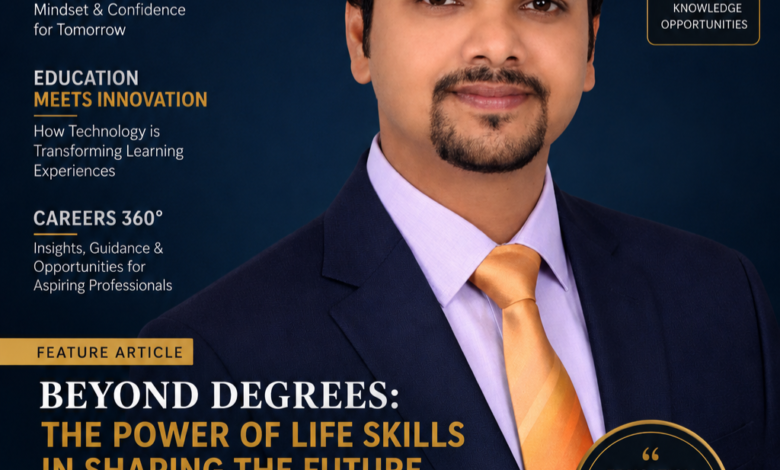
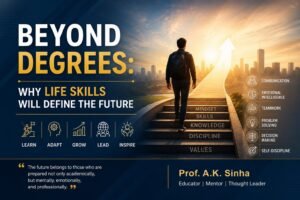
In his thought-provoking article, “Beyond Degrees: Why Life Skills Will Define the Future,” educationist and academic leader Prof. A.K. Sinha highlights the urgent need to rethink traditional educational priorities. While degrees and certifications remain important indicators of academic achievement, he emphasizes that the ability to communicate effectively, think critically, adapt to change, collaborate with others, and demonstrate emotional intelligence will be equally—if not more—important in the years ahead.
The Changing Nature of Work
The global workforce is undergoing a dramatic transformation. According to international labor and industry reports, many routine and repetitive tasks are increasingly being automated. Jobs that exist today may evolve significantly or disappear altogether within the next decade, while entirely new professions will emerge.
In such an environment, technical knowledge alone is insufficient. Employers are increasingly seeking professionals who can solve complex problems, work effectively in teams, demonstrate leadership, and adapt quickly to changing circumstances.
“Future careers will not be defined solely by what people know, but by how effectively they can apply knowledge in real-world situations,” says Prof. Sinha.
The ability to learn continuously, embrace innovation, and navigate uncertainty has become a critical requirement across all sectors, from education and healthcare to engineering, business, and public administration.
Why Life Skills Matter More Than Ever
Life skills encompass a broad range of personal, social, and professional competencies that enable individuals to manage challenges, make informed decisions, and contribute positively to society. These include:
- Critical Thinking and Problem Solving
- Communication and Presentation Skills
- Emotional Intelligence and Self-Awareness
- Leadership and Teamwork
- Creativity and Innovation
- Adaptability and Resilience
- Decision-Making and Time Management
- Digital Literacy and Ethical Responsibility
Experts believe that these competencies help individuals navigate both professional responsibilities and personal challenges more effectively.
For example, a technically qualified engineer may possess extensive subject knowledge, but without communication skills and teamwork abilities, their effectiveness in a collaborative workplace may be limited. Similarly, a business graduate may hold an advanced degree but struggle to succeed if they cannot adapt to rapidly changing market conditions.
The Education System at a Crossroads
Traditional education systems have long focused on examinations, grades, and theoretical knowledge. While these remain important, critics argue that excessive emphasis on academic performance often leaves students underprepared for real-world challenges.
Prof. Sinha advocates for a more holistic approach to education—one that balances academic excellence with personal development. He suggests that institutions should create learning environments that encourage curiosity, creativity, collaboration, and practical problem-solving.
Project-based learning, experiential education, internships, community engagement, entrepreneurship programs, and leadership development initiatives can play a crucial role in nurturing these essential skills.
“The purpose of education should not merely be to produce degree holders. It should be to develop capable, confident, ethical, and socially responsible citizens,” he argues.
Artificial Intelligence and the Human Advantage
The rise of artificial intelligence has intensified discussions about the future of work and education. While AI systems can process information, generate content, and perform analytical tasks with remarkable efficiency, they cannot fully replicate uniquely human qualities such as empathy, ethical judgment, creativity, emotional understanding, and interpersonal connection.
As technology assumes a larger role in routine tasks, these human-centered skills are expected to become even more valuable.
Experts predict that future leaders will be distinguished not only by their technical expertise but also by their ability to inspire teams, foster innovation, manage diversity, and make responsible decisions in complex situations.
Preparing Students for an Uncertain Future
Educational institutions, policymakers, parents, and industry leaders all share responsibility for preparing young people for a rapidly changing world. This requires a shift from a narrow focus on academic achievement toward a broader vision of lifelong learning and skill development.
Students must be encouraged to become active learners, effective communicators, collaborative problem-solvers, and responsible global citizens. Equally important is fostering resilience—the ability to adapt, recover, and grow in the face of challenges and uncertainty.
A New Vision for Success
The future of education is not about choosing between degrees and skills; it is about integrating both. Academic knowledge provides the foundation, while life skills enable individuals to apply that knowledge meaningfully and effectively.
As society moves deeper into the age of intelligence and innovation, educational success must be measured not only by certificates earned but also by the capacity to think, adapt, create, lead, and contribute.
The message emerging from experts such as Prof. A.K. Sinha is clear: degrees may open opportunities, but life skills will determine long-term success.
“In the future, the most successful individuals will not necessarily be those with the highest qualifications, but those who possess the adaptability, creativity, emotional intelligence, and leadership needed to navigate a changing world.”
Prof. A.K. Sinha is an academician, researcher, and education thought leader whose work focuses on innovation, technology-enabled learning, skill development, and the future of education.