
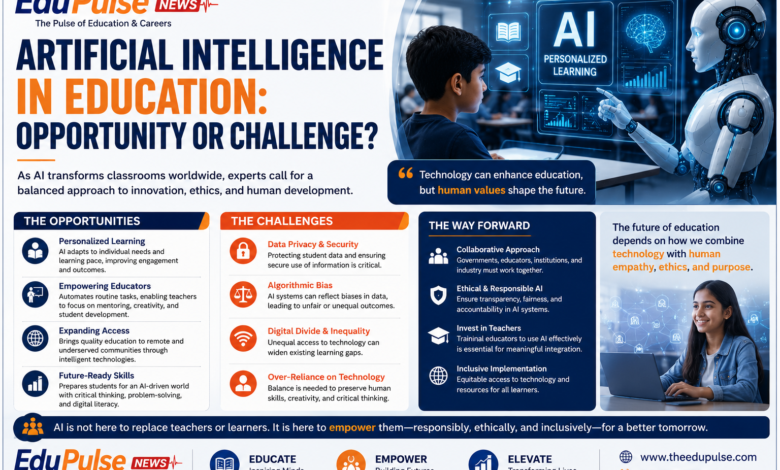
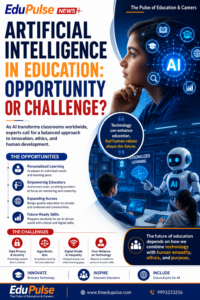
Artificial Intelligence in Education: Opportunity or Challenge?
As AI-Powered Technologies Reshape Classrooms, Experts Call for a Balanced Approach to Innovation, Ethics, and Human Development

Warning: Undefined variable $html in /home/u877949971/domains/theedupulse.com/public_html/wp-content/plugins/custom-banners/custom-banners.php on line 473
EduPulse Media Bureau
The integration of Artificial Intelligence (AI) into education is rapidly transforming how students learn, teachers teach, and institutions operate. Once considered a futuristic concept, AI has now become a central component of educational innovation, influencing everything from personalized learning and automated assessments to academic administration and student support services.
Governments, universities, schools, and technology companies across the world are investing heavily in AI-driven educational solutions, viewing them as tools capable of addressing longstanding challenges related to accessibility, quality, efficiency, and learning outcomes. Yet, as adoption accelerates, educators and policymakers are increasingly debating a critical question: Does AI represent an unprecedented opportunity for education, or does it introduce challenges that could fundamentally alter the nature of learning?
A Paradigm Shift in Learning
Education experts describe AI as one of the most disruptive technologies to influence the sector since the advent of the internet. Unlike traditional digital tools, AI systems possess the ability to analyze data, recognize patterns, adapt to learner behavior, and provide real-time recommendations.
This capability is enabling a shift away from standardized instructional models toward personalized learning experiences. AI-powered platforms can identify individual strengths and weaknesses, recommend targeted content, and adapt learning pathways according to student performance.
Educational researchers argue that such innovations have the potential to improve engagement, increase retention, and support diverse learning needs more effectively than conventional approaches.
Transforming the Role of Educators
Contrary to widespread concerns regarding job displacement, experts emphasize that AI is unlikely to replace teachers in the foreseeable future. Instead, the technology is expected to redefine the educator’s role.
Routine administrative responsibilities—including grading, attendance management, data analysis, and content organization—can increasingly be automated through intelligent systems. As a result, teachers may devote more time to mentoring, facilitating discussion, fostering creativity, and supporting students’ social and emotional development.
Educational leaders maintain that while AI can process information efficiently, it cannot replicate the empathy, ethical judgment, inspiration, and human connection that remain essential to effective teaching.
Expanding Educational Access
One of the most significant opportunities associated with AI lies in its potential to democratize education. Intelligent tutoring systems, multilingual learning platforms, speech-recognition technologies, and adaptive learning applications are making educational resources more accessible to learners across geographical and socioeconomic boundaries.
Students in remote and underserved communities can increasingly access high-quality learning experiences that were previously limited to well-resourced institutions. Similarly, AI-assisted technologies are improving educational opportunities for learners with disabilities through customized support mechanisms and assistive tools.
Advocates argue that, if implemented equitably, AI could play a pivotal role in reducing educational disparities worldwide.
Emerging Risks and Ethical Concerns
Despite its transformative potential, AI presents significant challenges that cannot be overlooked. Data privacy, cybersecurity, algorithmic bias, and the ethical use of student information have emerged as major concerns within the education sector.
Experts warn that educational institutions must establish robust governance frameworks to ensure transparency and accountability in AI deployment. The collection and analysis of large volumes of student data raise important questions regarding consent, ownership, and responsible usage.
Additionally, concerns persist that unequal access to digital infrastructure may widen existing educational gaps, creating a divide between those who can benefit from advanced technologies and those who cannot.
Preparing Learners for an AI-Driven Economy
The rise of AI is also reshaping labor markets, prompting educational institutions to reconsider how students are prepared for future careers. Industry analysts predict that many routine occupations will undergo substantial transformation, while entirely new professions will emerge.
Consequently, educational systems are placing greater emphasis on transferable skills such as critical thinking, problem-solving, creativity, communication, collaboration, and adaptability. These competencies are increasingly viewed as essential for success in an economy where technological change is constant.
Experts argue that future graduates will require not only technical knowledge but also the capacity for lifelong learning and continuous reskilling.
The Human Element Remains Central
While AI offers remarkable capabilities, education specialists consistently emphasize that technology should complement rather than replace human-centered learning. Education serves broader purposes than knowledge transmission alone; it is also responsible for nurturing values, character, citizenship, and interpersonal understanding.
Researchers caution against viewing technological advancement as an end in itself. Instead, they advocate for educational models that integrate innovation while preserving the human relationships and ethical foundations that define meaningful learning experiences.
Looking Ahead
As educational institutions navigate an increasingly digital future, the successful integration of AI will depend on thoughtful policy, responsible implementation, and equitable access. The coming decade is likely to witness continued experimentation, investment, and debate regarding the role of intelligent technologies in classrooms and campuses worldwide.
Whether AI ultimately proves to be an opportunity or a challenge may depend less on the technology itself and more on how societies choose to deploy it. Experts agree that the goal should not be to create technology-driven education systems, but rather education systems that leverage technology to enhance human potential.
Conclusion
Artificial Intelligence is poised to become one of the defining forces shaping the future of education. Its ability to personalize learning, support educators, and expand access presents extraordinary opportunities for educational advancement. At the same time, concerns related to ethics, privacy, equity, and human development demand careful attention.
As the education sector enters a new era of digital transformation, balancing technological innovation with human values will remain the central challenge—and perhaps the greatest opportunity—of all.
By EduPulse Media Editorial Desk
EduPulse Media | The Pulse of Education & Careers